Abstract
Precise and versatile 9-DoF pose control is crucial for controllable visual content generation, enabling users to specify the location, size, and orientation of designated objects in 3D space. However, existing approaches are typically designed for either text-to-image (T2I) or text-to-video (T2V) tasks, and are constrained by generation quality and control flexibility. In this work, we present SceneDesigner++, a unified framework for 9D pose control across both T2I and T2V generation. To provide comprehensive supervision, we construct ObjectPose9D++, a dataset containing high-quality images and videos featuring accurate pose annotations. Trained on ObjectPose9D++, SceneDesigner++ combines absolute and relative pose encoding strategies to decouple frame-wise spatial grounding from inter-frame motion modeling. Specifically, the absolute mechanism leverages the CNOCS map sequence to provide exact 9D pose configuration for each frame. Meanwhile, our relative pose encoding, termed VPRoPE, incorporates pose cues into rotary position embedding to explicitly model inter-frame pose transition, thereby enabling temporally coherent object motion. A learnable orthogonal transformation is further introduced for each attention head, allowing different heads to model distinct geometric patterns while preserving feature norms for stable training. We further introduce a multi-stage training strategy to learn these encoding mechanisms separately with minimal additional parameters. Benefiting from this lightweight and decoupled design, SceneDesigner++ also supports integration with independently learned camera-control modules, enabling separate or joint control over object and camera motion. Finally, we introduce T2IVPoseEval, a comprehensive benchmark for evaluating diverse object poses and motion patterns in both T2I and T2V tasks. Extensive experiments on this benchmark demonstrate that SceneDesigner++ consistently outperforms competing methods in pose fidelity and motion quality.
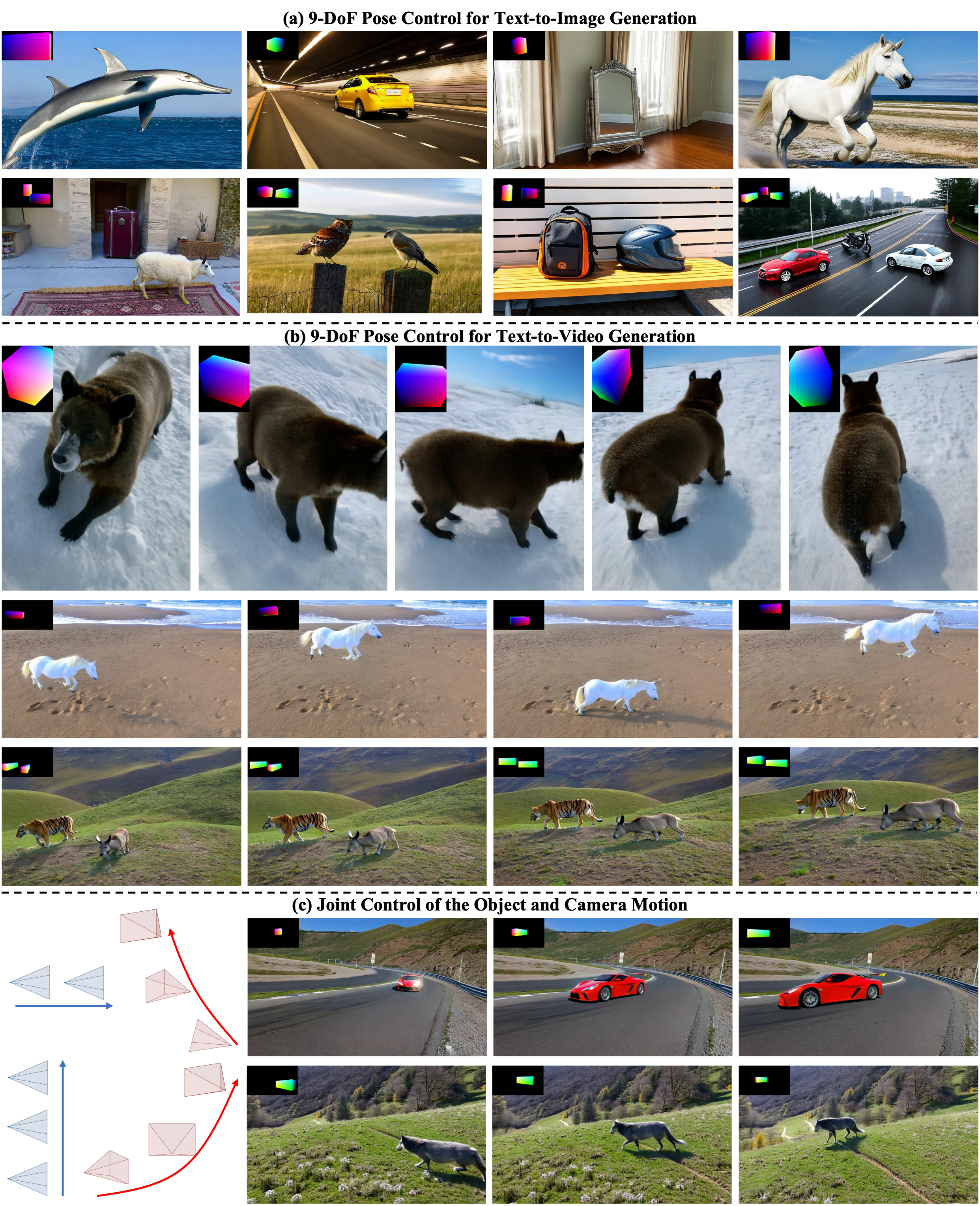
9-DoF Control Results from SceneDesigner++
Methodology
SceneDesigner++ Dataset. We construct a large-scale dataset of images and videos with accurate 9D object pose annotations. The data are collected from internal, domain-specific, and synthetic sources, whose annotations are obtained through model-based estimation, provided pose labels, and ground-truth states recorded by rendering engines, respectively. All annotations are converted into a unified CNOCS representation, enabling joint training for text-to-image and text-to-video generation.
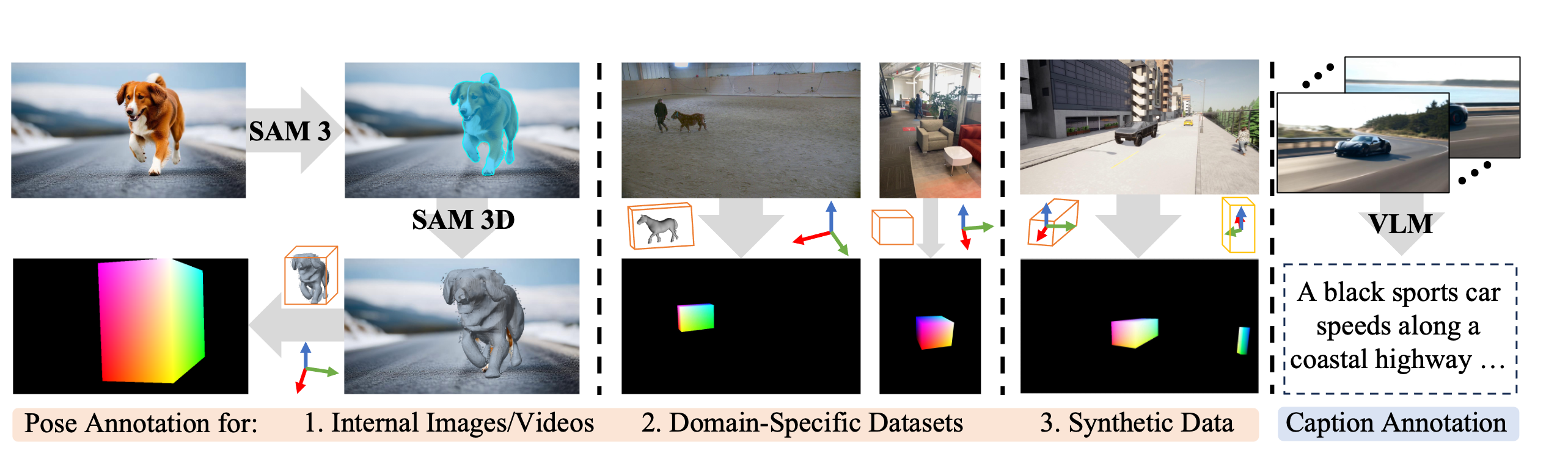
Complementary Pose Encodings. SceneDesigner++ combines two complementary pose encoding mechanisms. In particular, absolute pose encoding provides dense, frame-wise spatial grounding, whereas relative pose encoding models relative pose relationships within the attention operation. Together, they enable accurate 9D pose control while maintaining temporally coherent object motion.
Absolute Pose Encoding. Given the CNOCS map, we first extract its pose feature using \( \Phi_{\theta}^{\mathrm{cnocs}} \). The feature is then fused with the noisy visual latent \( \hat{\mathbf{z}} \) and processed by \( \Phi_{\theta}^{\mathrm{proj}} \):
The resulting pose-conditioned latent \(\mathbf{z}'\) is directly fed into the subsequent network blocks, eliminating the need for an additional ControlNet-style branch and its associated computational and memory overhead.
Relative Pose Encoding. Absolute encoding provides accurate frame-wise pose control but fails to explicitly model inter-frame pose transitions. We therefore introduce VPRoPE (Video Pose RoPE), which directly conditions attention scores on relative object poses. We explore the following two variants:
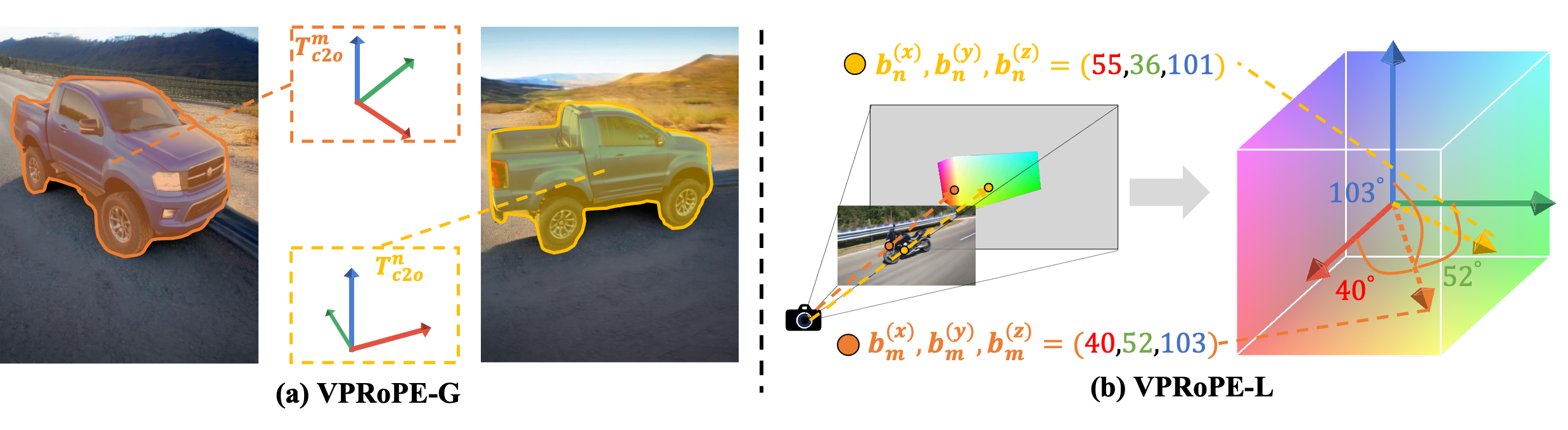
VPRoPE-G. The global formulation incorporates the camera-to-object transformation \(\mathbf{T}^{m}_{\mathrm{c2o}}\) into the attention score:
Thus, the attention between \(m\)-th and \(n\)-th tokens explicitly depends on their global relative object pose.
VPRoPE-L. To capture fine-grained geometric relationships, the local formulation derives per-pixel direction angles \(\mathbf{b}=(b^{(x)},b^{(y)},b^{(z)})\) from CNOCS map and leverages the following rotary transformations:
where \(\operatorname{BD}\) constructs a block-diagonal matrix and \(\theta_i=\theta_\text{base}^{-2i/d}\) (typically \(\theta_\text{base}= 10000\)) determines the channel-wise frequency. As indicated in the above equation, VPRoPE-L preserves the multi-frequency structure of RoPE while establishing dense, pixel-level relative pose relationships.
The figure below illustrates these two variants:
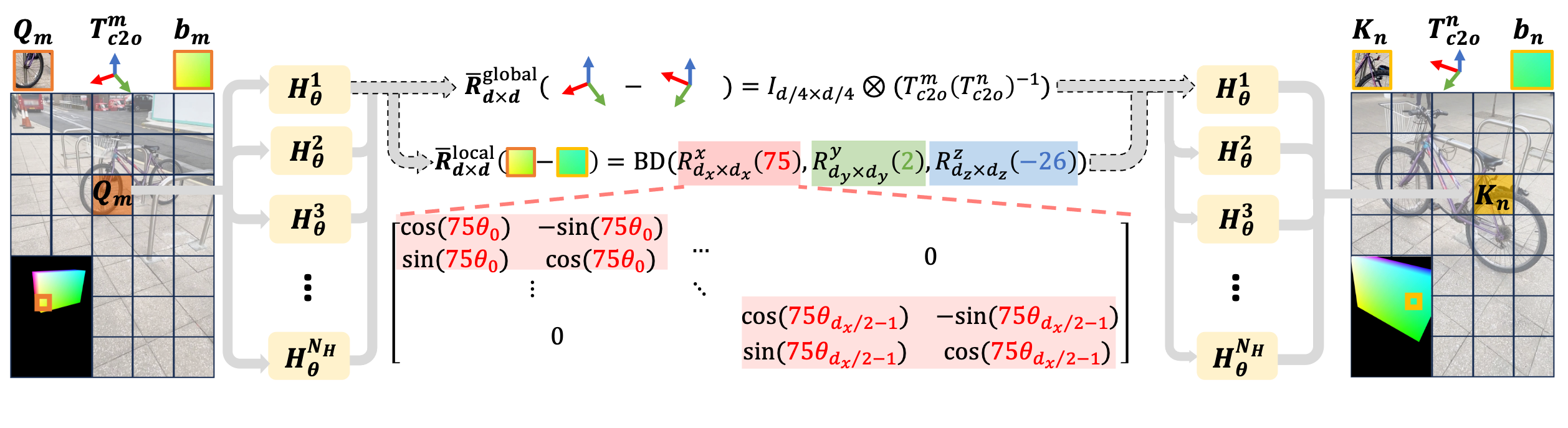
To efficiently incorporate VPRoPE while preserving the pretrained motion prior, each attention head learns an orthogonal transformation \( \mathbf{H}_{\theta,h} \). It maps features into a head-specific basis without changing their norms:
Consequently, all heads share the same relative pose while interpreting it in different learned subspaces, capturing complementary geometric and motion relationships. Importantly, the head-wise transformation does not alter the conditioning nature of VPRoPE: the resulting attention score remains conditioned on the relative object poses:
Experiments
The following figure evaluates the 9-DoF pose controllability of different methods in the T2I task, where our method achieves better pose fidelity.
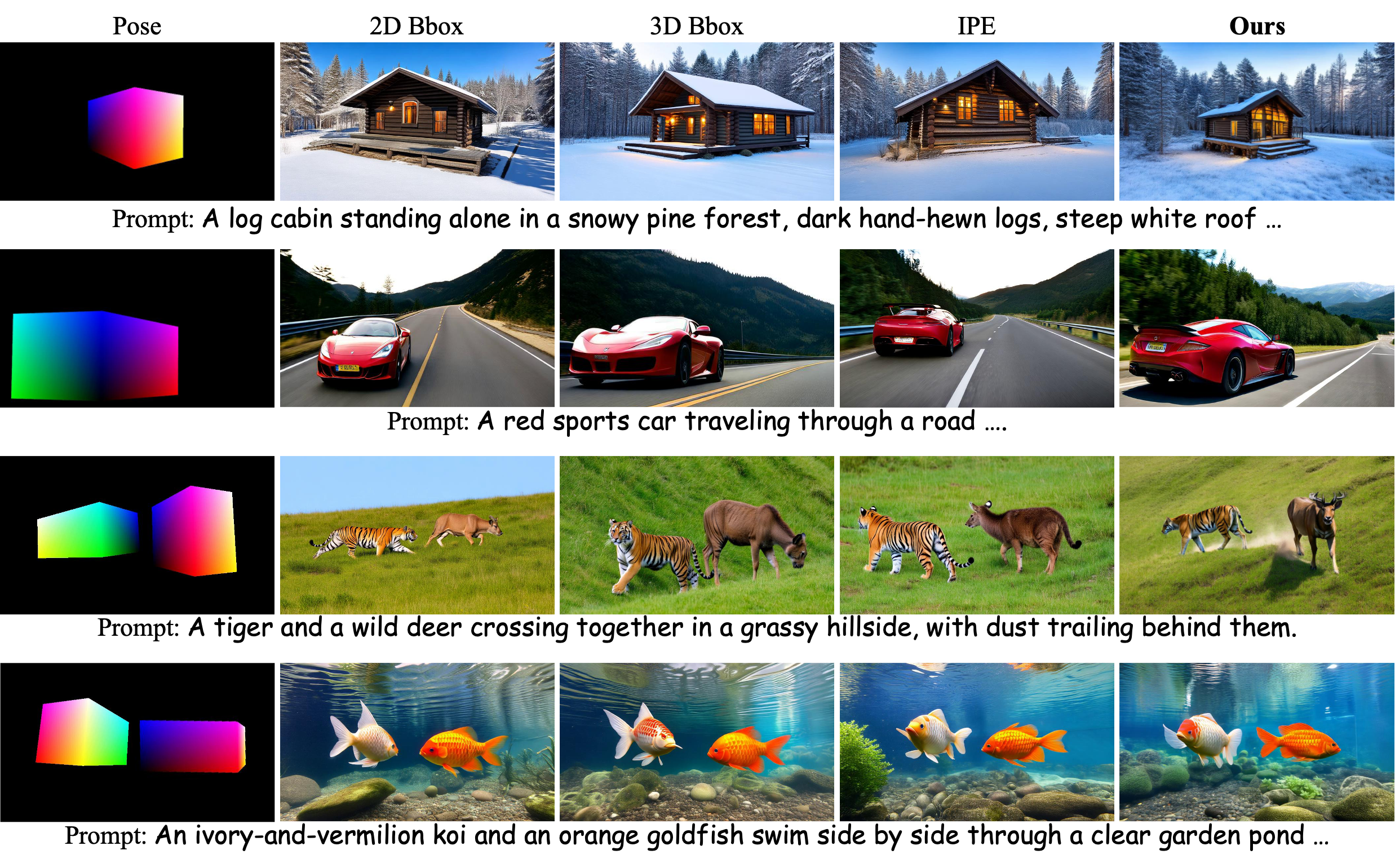
Qualitative results in T2I task.
The following figure compares the generated results for the T2V task. Our method achieves the most coherent object motion, while exhibiting better pose accuracy.
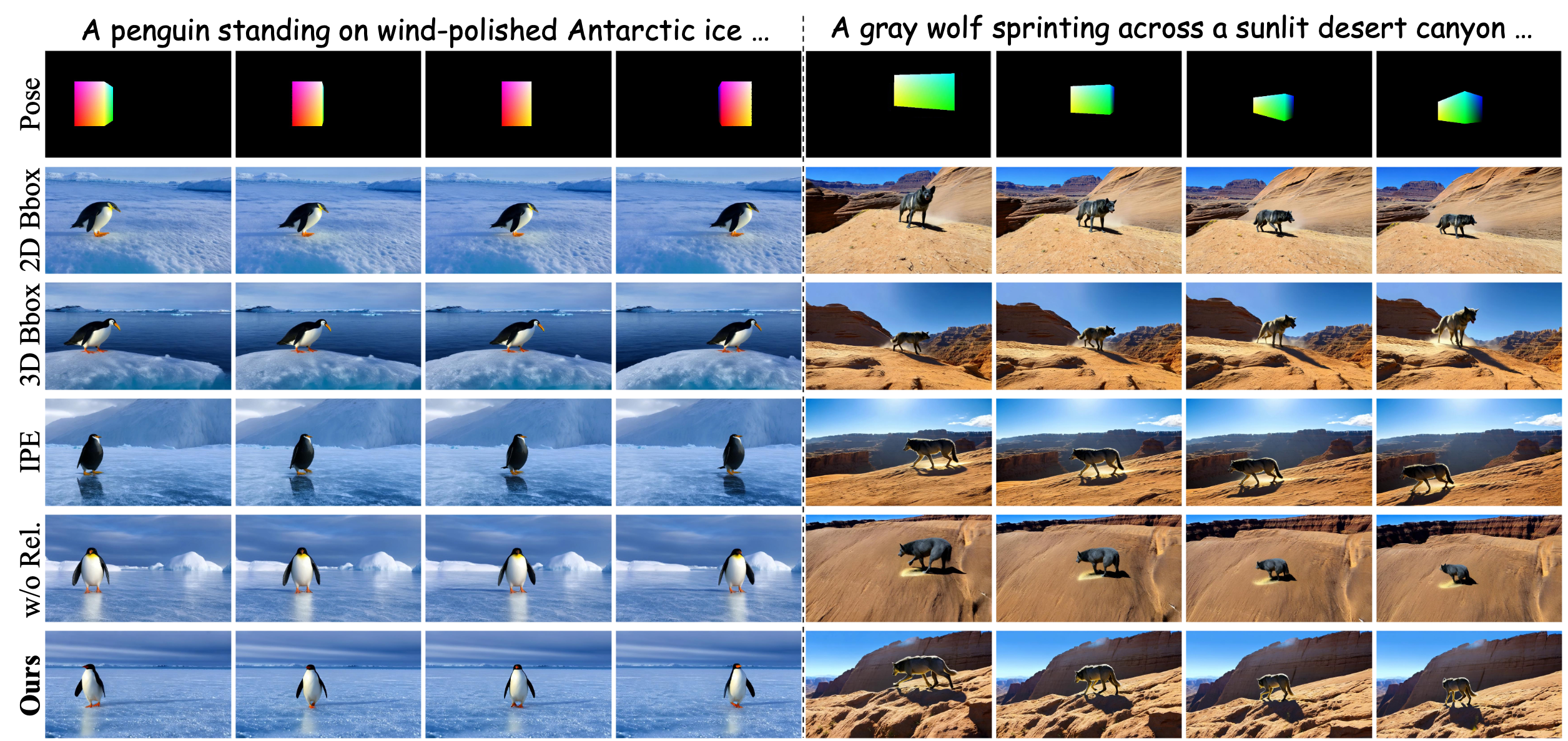
Qualitative results in T2V task.
We further present results demonstrating joint control over object and camera motion below.
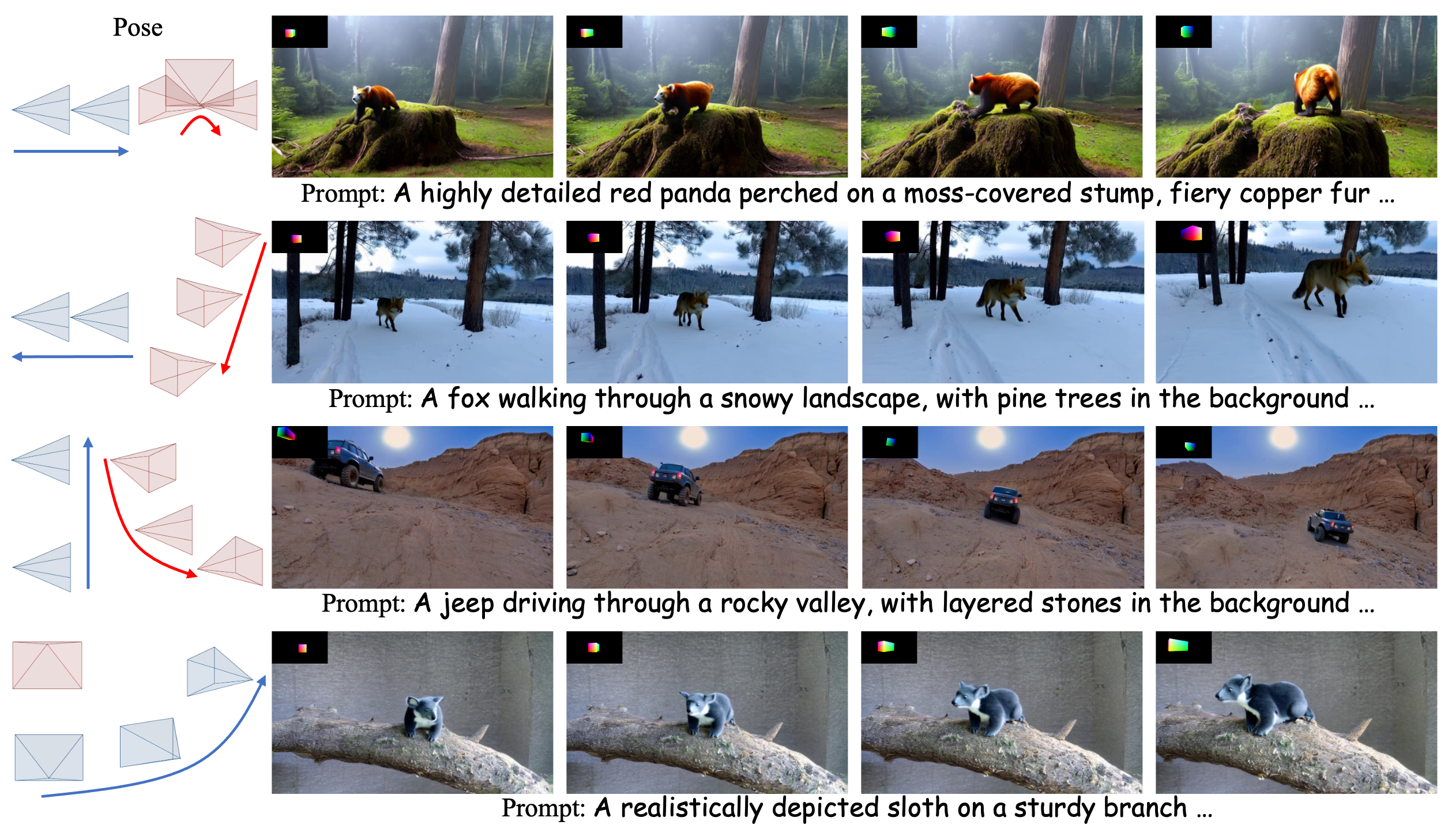
Joint control of object and camera motion.